
A national organization combining Afghan leadership, community trust and donor-compliant delivery capacity.
Care of Afghan Families (CAF) is an independent, non-governmental, non-political and not-for-profit Afghan organization. It was established in January 2003 by senior Afghan professionals with experience in Action Contre la Faim (ACF), the International Federation of Red Cross and Red Crescent Societies, and the World Health Organization. CAF was created to retain international knowledge within a sustainable national institution. It now delivers health, nutrition, community development, education, research, and women and youth empowerment programs through public systems and community networks.
LEGAL STATUS | Independent Afghan NGO; non-governmental, non-political and not-for-profit |
REGISTRATION | Initial registration: former Ministry of Planning, No. 946, 9 January 2003. Re-registration: Ministry of Economy, No. 68, 29 September 2005. Current Ministry of Economy certificate: No. 68, valid to 23 January 2027. |
HEAD OFFICE | Kabul, Afghanistan |
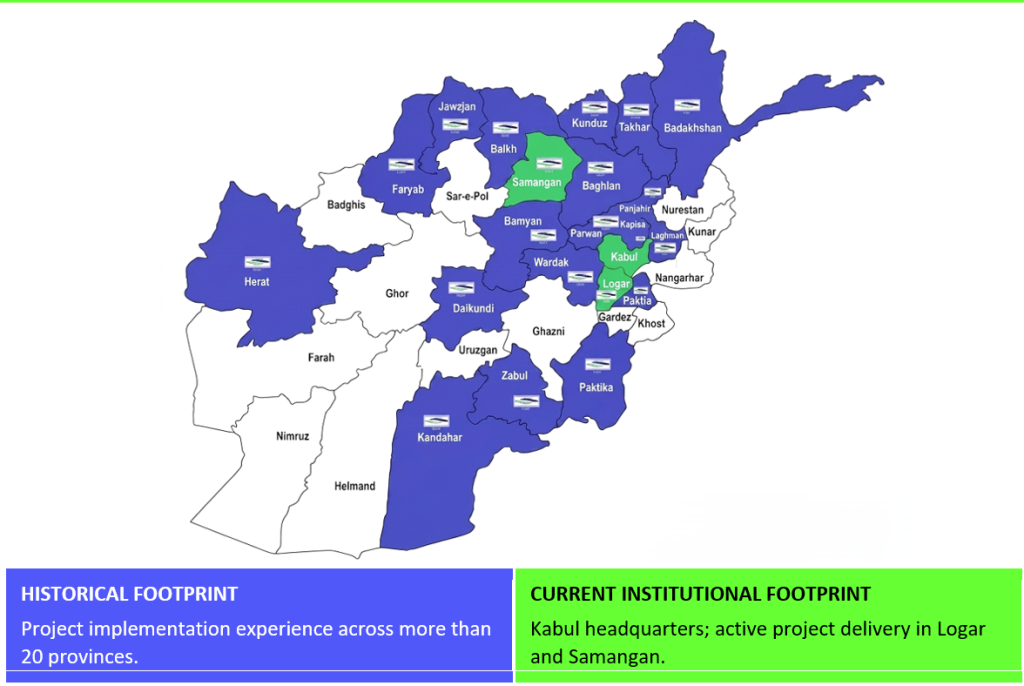
CURRENT PLATFORM | Head office in Kabul and four active projects delivering in Logar and Samangan as of September 2026. CAF is ready to mobilize and work in any province of Afghanistan, subject to program scope, access, security and partner agreement. |
AIM To improve the quality of life and living conditions among Afghan families. | VISION Self-reliant, aware and healthy Afghan families. | MISSION To enable families to fight poverty, injustice and unawareness. |
Why donors and international partners work with CAF
• Long-term national delivery: more than 23 years of implementation in complex and resource-constrained environments.
• Technical depth: proven capability in primary health care, hospital services, nutrition, disease control, community systems, community development, women and youth empowerment, education and research.
• Local access and acceptance: experienced provincial teams, community health workers, hospital and health-facility shuras, community leaders and influencers.
• Stewardship at scale: 182 completed and 4 active projects, representing a cumulative registered portfolio of US$182.71 million through September 2026.
• Flexible partnership role: experience as lead grantee, subrecipient, consortium member, field implementer, research partner and capacity-strengthening partner.
CAF’s Geographic Footprint
Strategic Direction
CAF connects lifesaving services with stronger families, capable local institutions and evidence for better decisions.
HEALTH & NUTRITION Primary and hospital care; maternal and child health; nutrition; TB and malaria; HIV, mental health; disability services; emergency and outbreak response. | COMMUNITY DEVELOPMENT Community mobilization; WASH and CLTS; community-based nutrition; social promotion; support to displaced people and returnees. |
EDUCATION & RESEARCH Community midwifery and nursing education; workforce development; organizational capacity building; surveys, evaluations and operational research. | WOMEN & YOUTH EMPOWERMENT Survivor-cantred protection and referral; psychosocial support; life skills and vocational training; internships and pathways to employment. |
Governance, leadership and people
Clear oversight, experienced management and continuous staff development underpin CAF’s accountability.
Governance structure
GENERAL ASSEMBLY | CAF’s final decision-making body. It brings together members of the Trustee, Advisory and Management Boards and approves the Director General, charter amendments, strategic direction, annual performance, plans and budgets. |
BOARD OF TRUSTEES | Volunteer oversight of mission, strategy, organizational performance, stewardship and accountability. |
ADVISORY BOARD | Institutional memory and strategic or technical advice from founders and experienced professionals. |
MANAGEMENT BOARD | Executive leadership of programs, technical quality, finance, administration, procurement, human resources, risk and day-to-day delivery. |
People and technical capacity
CAF’s leadership and management team combines medical, public health, nutrition, pharmacy, MEAL, finance, internal audit, procurement, logistics, human resources, administration, community development and research expertise. This multidisciplinary structure supports technical oversight, donor compliance and day-to-day service delivery
from headquarters to health facilities and communities.
1,027 STAFF REPORTED IN FY2025 | 380 FEMALE STAFF | 647 MALE STAFF | 418 COMMUNITY HEALTH WORKERS |
COMPETENCY-BASED STAFFING Recruitment against approved qualifications, clear job descriptions, reporting lines, orientation and performance expectations. | CONTINUOUS DEVELOPMENT Training needs assessment, technical refreshers, coaching, management education and learning from supervision and program data. |
FEMALE SERVICE CAPACITY Female professionals and community workers are central to reaching women, newborns, children and survivors safely and appropriately. | DUTY OF CARE Security, safety, staff welfare, incident management and context monitoring support responsible field deployment. |
LOCALIZATION LEADERSHIP CAF has supported the establishment or systems strengthening of several national organizations, including SHDP, BARAN, OPHA, OREAD and CAF-CDO, and has |
Portfolio and current platform
A 23-year delivery record, backed by an active platform with UN partners and a clear national scale-up offer.
186 PROJECTS IN THE REGISTER | 182 COMPLETED PROJECTS | 4 ACTIVE PROJECTS | US$182.71M REGISTERED PORTFOLIO VALUE |
Cumulative project portfolio through September 2026

Source: CAF List of Projects 2003 to Date, updated September 2026. Registered values by principal program area: health and nutrition US$177.85M; community development US$2.44M; women and youth empowerment US$1.56M; education US$0.48M; research and evaluation US$0.38M. Rounding may affect displayed totals.
Current projects
PARTNER | ACTIVE INITIATIVE | LOCATION | CURRENT TERM |
UNICEF | SAFE: BPHS and EPHS | Logar | to 31 Dec 2026 |
UNDP / Global Fund | GC7 malaria, TB and HIV | Logar | to 31 Dec 2026 |
UNFPA | Essential RMNCAH services | Logar & Samangan | to 31 Dec 2026 |
WFP | Targeted Supplementary Feeding | Logar | to 31 Dec 2026 |
HUMANITARIAN COMMITMENT CAF delivers assistance according to the principles of humanity, neutrality, impartiality and operational independence, with transparency and accountability, while respecting Afghan law, donor-agreement requirements and the dignity of affected people. |
Core capability: health and nutrition
CAF’s largest program pillar brings together public health systems, health facility-based care and community outreach.
PORTFOLIO SCALE 135 health and nutrition projects with a registered value of approximately US$177.85 million in the project register updated September 2026. |
PRIMARY CARE & HOSPITALS BPHS and EPHS delivery; outpatient, inpatient, emergency, surgical, diagnostic, pharmacy, laboratory, blood transfusion, imaging and referral services. | MATERNAL, NEWBORN & CHILD HEALTH Antenatal, delivery and postnatal care; family planning; newborn care; immunization; IMCI; reproductive and maternal health through facilities and FHHs. |
PUBLIC NUTRITION Growth monitoring; MIYCN; TSFP and CMAM; micronutrients; breastfeeding support; therapeutic feeding; nutrition screening, referral and community communication. | COMMUNICABLE DISEASES Tuberculosis (TB) case detection and DOTS; malaria prevention, testing and treatment; HIV awareness; community surveillance and referral. |
EMERGENCY & OUTBREAK RESPONSE Trauma and emergency care; mobile health teams; COVID-19 response; preparedness and response to measles, AWD, dengue, CCHF, malaria and other outbreaks. | SYSTEMS STRENGTHENING Health workforce development; CHW support; HMIS and program reporting; supportive supervision; medicines, cold chain, warehousing and facility operations. |
Delivery strengths
Continuity: Around-the-clock hospital, emergency and maternal services are supported by practical staffing, supply, referral and contingency plans. | Access for women and children: Female health workers and community-based models |
Quality assurance: Supervision, joint monitoring, clinical mentoring, data review and documented follow-up guide daily improvement. | Last-mile operations: CAF coordinates medicines, nutrition commodities, cold chain, fuel, oxygen, transport, repairs and other essentials. |
Community partnership: Hospital and health-facility shuras, CHWs, leaders and influencers shape outreach, referral and problem-solving. | Adaptive delivery: Field teams track access, disease patterns and operational constraints, then adjust outreach, staffing and logistics. |
Workforce readiness: Orientation, refresher training, coaching and surge arrangements reinforce safe and technically sound services. | Accountability to people: Feedback, complaints, confidentiality, safeguarding and PSEA expectations are integrated into service management. |
Last Five-year Service Delivery Record: 2021-2025
A portfolio-wide view of major projects and selected verified results from five consecutive annual reports.
YEAR / MAJOR | HEALTH | SELECTED |
2021 | 56 Logar BPHS/EPHS health facilities and 232 health posts; malaria services through 46 of the Logar facilities; 1 Afghan-Japan COVID-19 hospital; and 1 Logar COVID-19 hospital supported by 6 district COVID-19 centres. Reported volume: 2,485,859 public-health service contacts, 265,330 hospital contacts and 12,557 inpatient admissions. | 9,090 malaria tests through facilities and community posts; 779 staff trained; 414 CHWs refreshed; HMIS verification 99.8% EPHS and 96.4% BPHS. |
2022 | 56 Logar BPHS/EPHS health | 7,275 malaria tests through facilities and community posts; 435 staff and 272 CHWs trained; HMIS verification above 98.5% EPHS and 95.4% BPHS. |
2023 | HER/MHNT delivery network: 218 health facilities and teams across Logar (56), Parwan (86), Faryab (68) and Paktika (8); plus 31 Samangan FHHs and 25 Kapisa CBNP health facilities. Reported volume: 11,531,350 public-health service contacts, including 10,848,017 through HER, and 61,461 Paktika MHNT/HSC clients. | 496,015 people screened for TB; 64,232 TSFP participants supported; 898.55 MT of food distributed. |
FY2024 | 20 Mar 2024-19 Mar 2025 | 56 Logar BPHS/EPHS health facilities and 231 community health posts; 45 UNFPA FHHs (14 Logar and 31 Samangan). The Logar platform supported a catchment population of 577,418 and reported 21,795 institutional deliveries. Other projects used some of the same facilities. | 213,670 FHH service contacts; 495,840 people screened for TB and 1,386 diagnosed; 26,449 people received food support; TSFP cure rates exceeded SPHERE standards with zero reported mortality. |
FY2025 | 20 Mar 2025-20 Mar 2026 | 56 Logar BPHS/EPHS health facilities and 232 community health posts; 19 Global Fund-supported Logar health facilities; and 45 UNFPA FHHs (14 Logar and 31 Samangan). The Logar platform supported a catchment population of 577,418 and reported 21,795 institutional deliveries. Project networks overlap. | 563 new and relapse TB cases notified and treated with 98% treatment success; 5,684 suspected malaria cases tested and 758 confirmed cases treated; 401.5 MT of specialized nutritious food distributed; 2,139 safe FHH deliveries and 361 complicated maternal referrals. |
What these results demonstrate
•
Multi-project delivery: CAF sustained facility, hospital, mobile-team, nutrition, TB, malaria, FHH and protection work across changing funding environments.
• Quality and learning: third-party HMIS verification, supportive supervision, joint monitoring and routine review link field evidence to corrective action.
• Community reach: health posts, CHWs, FHHs, shuras and field teams extend essential services beyond fixed facilities.
• Partner visibility: annual reports, program records, financial reports and supporting documents preserve an auditable trail for donor review.
Flagship case study: one connected health system for Logar
FY ended 20 March 2026| A practical example of how CAF links facilities, communities, qualityassurance and last-mile operations.
THE OPERATING CHALLENGE Familiesin dispersed communities need more than a functioning clinic. They need aconnected pathway from the household and health post to primary care,referral and hospital services, supported by reliable supplies, female healthworkers, supervision and community trust. |
577,418 LOGARCATCHMENT POPULATION including 162,017 boys, 151,122 girls, | 56 HEALTHFACILITIES SUPPORTED | 232 COMMUNITYHEALTH POSTS |
How CAF delivered services
ONE SERVICENETWORK CAF supported the full BPHS /EPHS pathway: 56 facilities, including one provincial hospital, linked with 232 community health posts. | A TRUSTED COMMUNITY LINK Community health workers, health-facility shuras and community shuras helped families understand services, raise concerns and reach appropriate care. |
A VISIBLE QUALITY LOOP CAF recorded 606 supportive-supervision visits, 91 monitoring visits and 66 joint monitoring visits with the Provincial Public Health Directorate. | A PRACTICAL OPERATING BACKBONE Medicines, cold chain, nutrition commodities, transport, fuel, oxygen, repairs, staffing and referral arrangements were managed as part of one delivery system. |
COMMUNITY ACCOUNTABILITY 110 health-facility shura meetings and 627 community-shura meetings created regular space for dialogue and local problem-solving. | MATERNAL SERVICE RESULT 21,795 institutional deliveries were reported against a target of 19,446—112% of the annual target. |
Why this model matters to partners
• Scale with local connection: a provincial platform can retain direct links with families and community structures.
• Evidence with follow-through: supervision and joint monitoring turn routine data into practical corrective action.
• A platform for integration: the same operating backbone can support maternal health, nutrition, TB, malaria, emergency response and
referrals.
Key Performance Indicator 2025
Integrated programming beyond health
CAF complements health delivery with community systems, learning, protection and economic inclusion.
Community development
CAF has implemented 19 community development projects with a registered portfolio value of approximately US$2.44 million. Experience includes Community-Led Total Sanitation, sustainable water supply and sanitation, community-based nutrition, community health promotion, community mobilization and support to displaced people and returnees.
Education, capacity building and research
CAF has implemented 12 education projects and 17 research and evaluation projects. Its experience includes community midwifery and nursing education, CHW training, organizational development, project and financial management training, surveys, baseline and endline studies, formative research and operational learning.
192 COMMUNITY | 96 COMMUNITY | 18 NATIONAL NGOS | 17 RESEARCH AND |
Women and youth empowerment
Through Women Protection Centres, Family Guidance Centres and later Family Resource Centres, CAF delivered survivor-centred protection, psychosocial support, referral, education and vocational opportunities. By the end of these initiatives, 4,962 women and girls had received services, alongside 218 accompanying children. CAF also hosted 100 young graduates in internships, with an 80% employment rate reported after participation.
PROTECTION EXPERIENCE Safe, confidential and survivor-centred services linked with health, psychosocial, legal and community referral pathways. | YOUTH PATHWAYS Internships, workplace exposure, mentoring, life skills and vocational learning designed to improve employability. |
INTEGRATION IN PRACTICE CAF can combine facility services, nutrition, community engagement, protection, workforce development and evidence generation within one coordinated delivery |
Systems, compliance and accountability
CAF maintains an institutional control environment designed to protect resources, people, data and program quality.
FINANCIAL MANAGEMENT Approved budgets and coding; accounting records; bank and cash controls; payroll audit trails; reconciliations; donor financial reporting; annual external audit. | PROCUREMENT & LOGISTICS Procurement planning; competition and approvals; segregation of duties; supplier due diligence; contracting; inventory, warehousing, fleet and asset controls. |
HR & DUTY OF CARE Transparent recruitment; personnel files; job descriptions; performance management; | MEAL & INFORMATION Results frameworks; workplans; indicator tracking; HMIS and program systems; |
SAFEGUARDING, PSEA & ACCOUNTABILITY Zero-tolerance expectations; child safeguarding; gender- and GBV-sensitive practice; | RISK & INTEGRITY Risk registers and mitigation; conflict of interest; anti-fraud and anti-corruption; whistleblowing; AML and counter-terrorist financing safeguards; contract compliance. |
LOW RISK UNDP-COMMISSIONED | FULL (8) UNICEF PSEA | 29 APPROVED | 5 SUCCESSIVE |
CAF’s 29-policy control framework
CAF maintains 29 approved policies and procedures covering governance; finance and audit; procurement, logistics and assets; HR and staff conduct; risk, security and access; data and records; partnerships; anti-fraud, conflict of interest, whistleblowing and AML/counter-terrorist-financing controls; gender, child safeguarding, complaints and a dedicated PSEA policy. The controlled register, approved copies and version history are available for due diligence.
Due-diligence package available to partners
• Legal and governance: registration, charter, governance structure, organogram and delegations.
• Policies and controls: the 29-policy register, approved instruments and implementation tools.
• Financial assurance: audits, management responses, bank information and financial reports.
• Technical capacity: past performance, project register, staff CVs, monitoring tools and references.
Independent assurance and audit record
CAF presents positive opinions and identified follow-up items together, giving partners a transparent view of financial stewardship and control maturity.
ASSURANCE REVIEW | OPINION / SCOPE | HEADLINE RESULTS AND FOLLOW-UP |
Independent annual financial statements | Unqualified opinions in five successive audits. The 2021-2025 reports state that the audits were conducted under International Standards on Auditing. | The auditors reported that the financial statements presented CAF’s financial |
UNICEF HACT audit | Unmodified opinion on US$5,813,734 of World Bank-funded expenditure. | Two financial findings totalling US$1,607 (displayed as 0.0% of audited |
UNICEF HACT audit | Unmodified opinion on US$2,540,273 of World Bank-funded expenditure. | One financial finding of US$521 (displayed as 0.0%); no high-risk, 1 medium- and 1 low-risk control weakness; recommendations recorded for follow-up. |
UNFPA HACT audit | Unqualified opinion on AFN 101,997,806.15 of audited expenditure. | No financial findings; no high-risk, 1 medium- and 2 low-risk control weaknesses; two micro-assessment recommendations remained for follow-up. |
TRANSPARENT FOLLOW-UP CAF records management responses, assigns corrective actions and retains supporting evidence for donor review. HACT observations are treated as opportunities to |
ORGANIZATIONAL RISK A UNDP-commissioned BDO micro-assessment in 2024 rated CAF Low Risk, independently validating the broader control environment. | PSEA CAPACITY UNICEF’s UN Partner Portal review reached a final determination of Full capacity (8) |
Financial and grant management capacity
CAF combines program delivery with financial discipline, partner oversight and transparent reporting.
US$6.81M AUDITED INCOME, FY ENDED 20 MAR 2025 | US$6.84M AUDITED EXPENDITURE | US$2.49M TOTAL ASSETS AT YEAR-END | US$63,032 ACCUMULATED CORE FUND |
Audited Turnover reported across five financial statements 
Sub-grant and partnership management
CAF has managed donor funds and agreements with national subgrantees using written agreements, approved budgets and workplans, scheduled transfers, monthly liquidation, technical and financial review, monitoring, corrective follow-up and documented closeout.
1. START-UP Agreement review, due diligence, risk rating, roles, budget coding, workplan, reporting calendar and compliance orientation. | 2. DELIVERY Fundrelease against approvals, activity and expenditure tracking, technical support, field monitoring and issue escalation. | 3. ASSURANCE Financial liquidation, reconciliations, indicator verification, supporting documents, audit access and management follow-up. | 4. CLOSEOUT Final reporting, asset and balance reconciliation, document archiving, lessons |
PARTNER COMMITMENT Transparent costs, timely communication and early resolution of issues, with evidence available for due diligence and implementation. |
Partnerships, memberships and platforms
CAF connects national delivery capacity with government, UN, multilateral, bilateral, INGO and national NGO partnerships.
UN AND MULTILATERAL | WHO; UNICEF; WFP; UNDP / Global Fund; UNFPA; UNOPS; UN OCHA; World Bank; Asian Development Bank (ADB) |
BILATERAL AND INSTITUTIONAL | USAID; European Commission; GIZ; Swiss Agency for Development and Cooperation; Gavi |
GOVERNMENT AND PUBLIC SYSTEMS | Ministry of Public Health; Ministry of Economy; provincial public health directorates; local authorities; health-facility and community shuras |
INGO AND TECHNICAL PARTNERS | MSH; Jhpiego; Aga Khan Foundation / Aga Khan Health Services; Save the Children; BRAC; Medair; HealthNet TPO; Terre des Hommes |
Illustrative and non-exhaustive; partner roles and periods vary across CAF’s operating history.
Partnership modalities
CONSORTIUM OR CO-APPLICANT Joint design and delivery with clear technical roles, shared governance, coordinated risk management and consolidated reporting. | FIELD IMPLEMENTATION PARTNER Provincial and community delivery, recruitment, logistics, stakeholder engagement, monitoring and donor-compliant documentation. | TECHNICAL OR RESEARCH PARTNER Assessments, surveys, operational research, capacity building, clinical or public health expertise and learning products. | SUBRECIPIENT OR GRANT MANAGER Fund management, partner due diligence, contracting, monitoring, liquidation, compliance support and corrective follow-up. |
Memberships, registrations and policy contribution
•
AHO and clusters membership: Alliance of Health Organizations member; CAF’s Director General is listed on the 2026 AHO Steering Committee. CAF is also a confirmed Afghanistan Health Cluster member.
• Donor and vendor platforms: registered on SAM.gov, the UN Partner Portal (UNPP) and the United Nations Global Marketplace (UNGM); UNDP Quantum, Fund for NGOs, records are available for due diligence.
• National coordination: participation in the Country Coordinating Mechanism (CCM), health-system steering platforms and health, nutrition, GBV and WASH coordination.
• Policy development: technical inputs to the National Standard Treatment Guidelines, BPHS revisions and the National Health Strategy 2016-2020.
• Community coordination: routine engagement with public health authorities, community health workers, hospital and health-facility shuras, community leaders and influencers.
WHAT CAF BRINGS TO A CONSORTIUM OR PARTNERSHIP Afghan leadership, context knowledge, technical depth, community acceptance and responsible fund management. |
Evidence and recognition
CAF contributes to learning, applies evidence in program delivery and has been recognized for practical innovation.
Selected research and knowledge contributions
1. Seroprevalence of anti-polio antibodies in children from a polio high-risk area of Afghanistan: a cross-sectional survey 2017
Vaccine, 2018; includes a CAF-affiliated co-author. View publication
2. Third party monitoring for health in Afghanistan: the good, the bad and the ugly
BMJ Global Health, 2023; includes a CAF-affiliated co-author. View publication
3. An Alternative Funding Theory – a Metatheory – for Afghanistan
American Journal of Medical Sciences and Medicine, 2021; includes a CAF-affiliated author. View publication
Selected recognition
World Bank South Asia Development Marketplace: CAF won a regional grant for the Baby-Friendly Village Initiative, which was presented asa promising nutrition practice.
Innovation in access: CAF pioneered an mHealth demand-side financing initiative in four districts of Badakhshan to strengthen referral and service use among women and children.
Emergency hospital leadership: CAF was selected to manage the Afghan-Japan COVID-19 hospital, which served as a major diagnostic, treatment and laboratory training platform.
ACRONYM KEY BPHS — Basic Package of Health Services | EPHS — Essential Package of Hospital Services | CHW — Community Health Worker | FHH — Family Health House | HACT — Harmonized Approach to Cash Transfers | HER — Health Emergency Response | MEAL — Monitoring, Evaluation, Accountability and Learning | PSEA — |
Partnership priorities and invitation
CAF welcomes long-term, transparent partnerships that strengthen locally led action and measurable results for Afghan families.
Partnership priorities | 2026-2030
HEALTH & NUTRITION SCALE-UP Pursue at least five BPHS, five EPHS and five vertical health and nutrition projects including TB, Malaria, HIV by 2030, while strengthening quality, referral and workforce capacity. | RESILIENT COMMUNITIES Support five community-development projects and 200 community platforms or health shuras, with meaningful participation by women. |
WOMEN & YOUTH OPPORTUNITY Seek three funded empowerment initiatives that can provide skills and livelihood support to approximately 1,000 women and 1,000 young people. | EDUCATION & EVIDENCE Implement three education and research projects, build links with universities and embed practical research in program delivery. |
ENABLING PARTNERSHIPS CAF is seeking multi-year, flexible and technically complementary partnerships that support geographic expansion, donor diversification, stronger digital systems and institutional resilience. Targets remain subject to funding, access and partner agreement. |
LET’S WORK TOGETHER CAF is ready to support proposal co-design, rapid due diligence, consortium formation and responsible implementation. We invite donors, UN agencies, international NGOs and technical institutions to discuss where CAF’s national capacity can add the greatest value. |
PARTNERSHIP CONTACT Dr. Sayed Ashuqullah Majidi Director General House No. 2194, Street No. 7 Qala-e-Fathullah Khan, Kabul, Afghanistan | CONNECT +93 (0) 729 880 530 +93 (0) 729 880 523 caf.director.general@gmail.com cafkbl@gmail.com |
| PUBLIC EVIDENCE use the link below to review CAF’s published annual and audit reports. |
Care of Afghan Families (CAF) | Organization Profile 2026